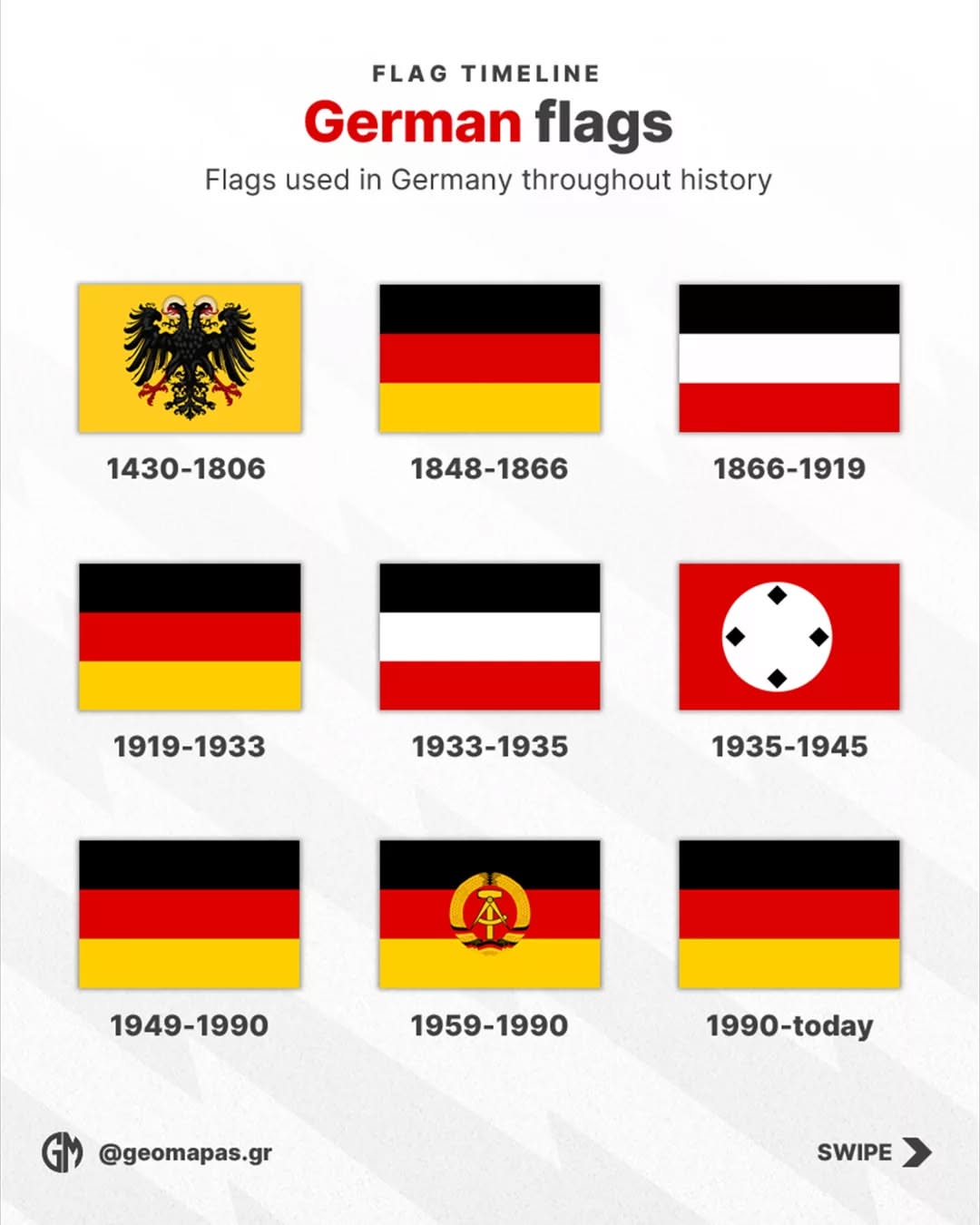
1430–1806: Holy Roman Empire
- Yellow/gold field with a black eagle (Reichsadler).
- Represented the Holy Roman Empire.
Why it changed: The empire was dissolved in 1806 after defeats by Napoleon Bonaparte, ending this symbol.
🟡⚫🔴 1848–1866: German Confederation / Revolution Era
- Black–red–gold tricolor emerges during the 1848 revolutions.
- Became a symbol of liberalism, unity, and democracy.
Why it changed: The revolutions failed, and conservative monarchies regained control, sidelining these colors.
⚫⚪🔴 1866–1919: North German Confederation & German Empire
- Black–white–red tricolor adopted under Otto von Bismarck.
- Combined:
- Black & white (Prussia)
- Red & white (Hanseatic cities)
Why it changed: Germany lost World War I, leading to the fall of the monarchy and the empire.
⚫🔴🟡 1919–1933: Weimar Republic
- Return to black–red–gold (democratic colors).
- Represented the new republic after the monarchy collapsed.
Why it changed: Political instability and economic crises led to the rise of extremist movements, including the Nazis.
⚫⚪🔴 1933–1935: Early Nazi Period
- Nazis initially reused the imperial black–white–red flag alongside their own.
Why it changed: They soon replaced it with a single, distinct ideological symbol.
1935–1945: Nazi Germany
- Red flag with white circle and black swastika (not naming the symbol explicitly here).
- Represented the regime under Adolf Hitler.
Why it changed: Germany’s defeat in World War II led to the collapse of the Nazi regime and banning of its symbols.
⚫🔴🟡 1949–1990: West Germany (Federal Republic)
- Black–red–gold restored as a symbol of democracy and continuity with Weimar ideals.
- Used by West Germany.
Why it changed: Germany was divided after WWII; this flag represented the western democratic state.
⚫🔴🟡 + emblem 1959–1990: East Germany (GDR)
- Same tricolor, but with a hammer and compass emblem surrounded by wheat.
- Represented socialism and workers under East Germany.
Why it changed: The division of Germany ended in 1990.
⚫🔴🟡 1990–Today: Unified Germany
- Black–red–gold retained after reunification.
- Represents a democratic, unified Germany.
Why it changed (last time): After German reunification, West Germany’s system and flag became the national standard.
Origins of Black-Red-Gold
1. Lützow Free Corps (1813–1815)
The most widely accepted origin comes from a volunteer unit in the wars against Napoleon Bonaparte.
- Unit: Lützow Free Corps
- Uniform:
- Black coats (cheap, easily dyed fabric)
- Red trim
- Brass/gold buttons
👉 This combination, black, red, gold, became associated with resistance and German unity.
2. Student Movements & Early Nationalism
After the wars, many veterans became students and activists.
- University groups (Burschenschaften) adopted these colors
- They symbolized:
- National unity (Germany was still fragmented)
- Liberal ideals (constitutional government, rights)
A key moment:
- Hambach Festival (1832): large pro-democracy gathering where black–red–gold flags were prominently displayed
3. The 1848 Revolutions
During the revolutions across Europe:
- The Frankfurt Parliament (first attempt at a unified German state) adopted black–red–gold
- It became the first “official” German national flag
Meaning evolved into:
- Black → oppression or the past
- Red → struggle
- Gold → freedom / a better future
(This interpretation is symbolic rather than officially defined, but widely cited.)
4. Rejected by Monarchies
After the revolutions failed:
- Conservative rulers (especially Prussia) rejected black–red–gold
- They preferred black–white–red (imperial colors)
So the tricolor became a symbol of democracy in opposition to monarchy
5. Weimar Republic (1919)
After World War I:
- The monarchy collapsed
- Black–red–gold returned as the flag of democratic Germany
It explicitly represented:
- Republicanism
- Civil rights
- Break from imperial rule
6. Suppressed Under the Nazis
Under Adolf Hitler:
- Black-red-gold was banned
- Seen as a symbol of the hated Weimar democracy
7. Post–World War II Meaning
After World War II:
- Both East and West Germany initially used black-red-gold
- It became a shared symbol of a new beginning
West Germany especially emphasized:
- Democracy
- Rule of law
- Break from dictatorship
8. Modern Germany (1990–Today)
After German reunification:
- Black–red–gold became the unified national flag
- Represents:
- Democracy
- Unity
- Constitutional order
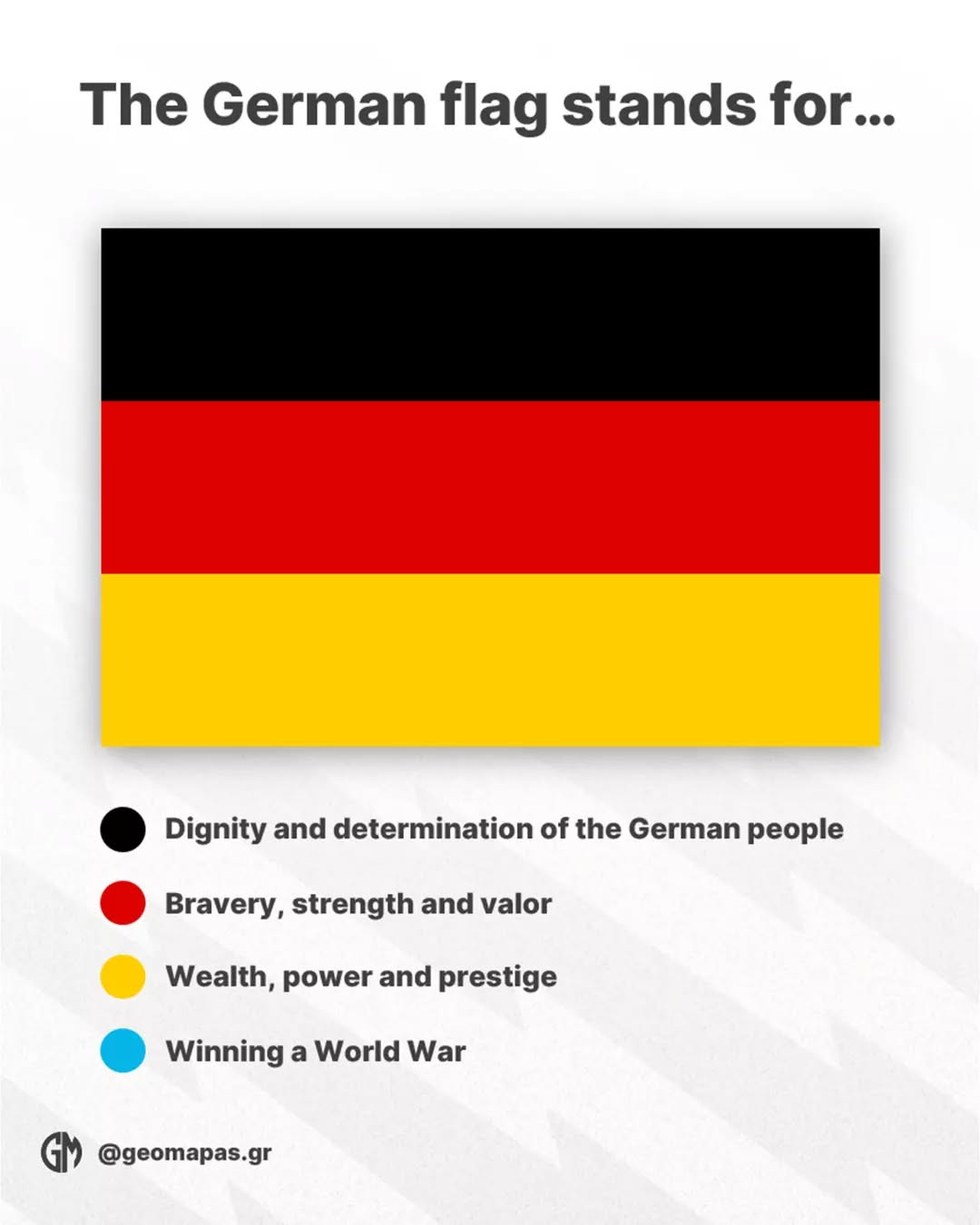
Alternatively, we have this meme:
Also see:
Leave a Reply