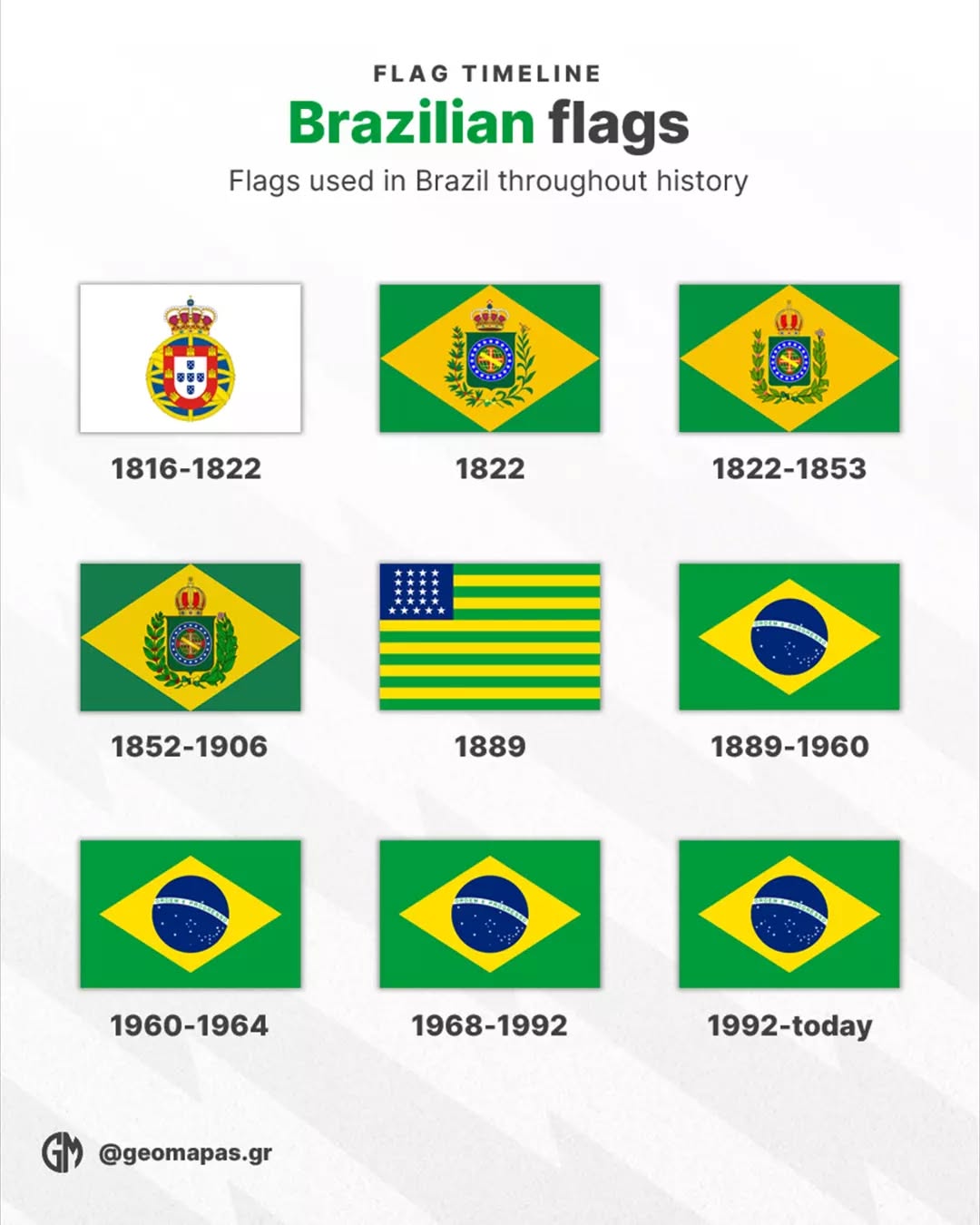
1816–1822: Kingdom of Brazil (Portuguese rule)
- Brazil was part of the United Kingdom of Portugal, Brazil, and the Algarves under John VI of Portugal.
- The flag used Portuguese royal symbols.
Why it changed: Brazil declared independence in 1822, ending Portuguese rule.
1822: First Imperial Flag (Independence)
- Created under Pedro I of Brazil.
- Introduced the green field and yellow diamond:
- Green = House of Braganza (Pedro I)
- Yellow = House of Habsburg (his wife)
Why it changed: This was an initial design that was quickly refined as the empire formalized its identity.
1822–1853: Early Empire Flag
- Featured a more detailed imperial coat of arms and crown.
- Represented the newly established Empire of Brazil.
Why it changed: Adjustments were made to reflect administrative and territorial organization.
1852–1906: Mature Empire Flag
- Used during the reign of Pedro II of Brazil.
- The coat of arms was updated, especially the number of stars representing provinces.
Why it changed: Brazil expanded internally, so symbols were updated to reflect its provinces.
1889: Provisional Republican Flag
- Introduced after the Proclamation of the Republic (Brazil).
- Looked similar to the U.S. flag (green/yellow stripes, blue canton with stars).
Why it changed: It was unpopular and seen as too influenced by the United States, lasted only a few days.
1889–1960: First Republican Flag (Modern Concept Begins)
- Introduced the current basic design:
- Green background + yellow diamond retained
- Blue globe with stars
- Motto: “Ordem e Progresso”, inspired by Auguste Comte
Why it changed: Brazil’s number of states increased over time, requiring updates to the stars.
1960–1964: First Star Expansion
- Stars updated to reflect new states and the new capital, Brasília.
Why it changed: Administrative changes required accurate representation.
1968–1992: Further Star Updates
- Additional stars added as Brazil continued to evolve politically.
Why it changed: More states = more stars.
1992–Today: Current Flag
- Contains 27 stars (26 states + Federal District).
- Maintains the same design introduced in 1889.
Why it changed (last time): Final adjustment to match Brazil’s modern political structure.
The Star Constellations
This is where Brazil’s flag becomes unusually precise and fascinating.
The Core Idea
The stars are not random, they depict the night sky over Rio de Janeiro on November 15, 1889, the day the republic was proclaimed.
- Specifically: around 8:30 AM local time (yes, a daytime sky, mapped astronomically)
- The sky is shown as if viewed from outside the celestial sphere, so it appears slightly mirrored compared to how we see it from Earth.
Major Constellations Represented
Here are the key constellations and what they symbolize:
Full Star–State Mapping (Current Flag – 27 Stars)
🌟 Key principle
- Each star = one Brazilian state or the Federal District
- Based on real stars visible over Rio de Janeiro on Nov 15, 1889
- The sky is mirrored (as if viewed from outside the celestial sphere)
⭐ Federal District
- Sigma Octantis (Octans)
- Represents Brasília (Federal District)
- Special because it lies near the South Celestial Pole
⭐ Southern Cross (Crux)
Very symbolic—central to the flag.
- Acrux (Alpha Crucis) → São Paulo
- Mimosa (Beta Crucis) → Rio de Janeiro
- Gacrux (Gamma Crucis) → Bahia
- Delta Crucis → Minas Gerais
- Epsilon Crucis → Espírito Santo
These are some of Brazil’s historically most important states.
⭐ Scorpius (largest group)
Represents many states, especially from the north and northeast.
Examples include:
- Antares (Alpha Scorpii) → Piauí
- Shaula (Lambda Scorpii) → Maranhão
- Sargas (Theta Scorpii) → Ceará
- Other Scorpius stars → states like Alagoas, Sergipe, Paraíba, Rio Grande do Norte, etc.
This constellation carries a large portion of the country’s representation.
⭐ Centaurus
- Alpha Centauri → Rio Grande do Sul
- Beta Centauri (Hadar) → Mato Grosso do Sul
Important southern and central-west regions.
⭐ Canis Major
- Sirius (brightest star in sky) → Mato Grosso
A prominent state represented by the brightest star.
⭐ Canis Minor
- Procyon → Amazonas
⭐ Triangulum Australe
- Stars in this constellation → Goiás and Tocantins
⭐ Hydra
- A long constellation with multiple stars:
- Represents states like Acre and others in the western/northern region
How the Stars Map to Brazil
- Each star = one Brazilian state (or the Federal District)
- The size of the star roughly reflects the importance or prominence (not strictly population)
- The arrangement preserves real astronomical positions, not political geography
The Motto Band
The white band with “Ordem e Progresso”:
- Represents the celestial equator
- Divides the sky into northern and southern halves
- Inspired by positivist philosophy:
- “Order as the basis, progress as the goal”
Subtle but Important Details
- The flag is one of the few in the world with an astronomically accurate star map.
- The stars are not symmetrical on purpose, they reflect real sky positions
- The design blends:
- Science (astronomy)
- Politics (states)
- Philosophy (positivism)
Finally see watch Brazil’s growth over time:
Also see:
Leave a Reply