The following 10 images show the flags of 120 countries that ceased to exist at some point in the 20th century. Some like the Ottoman Empire stretched back to the 13th century, while others like the Italian Social Republic barely lasted more than a year.
All of the images come from geomapas.gr who you should 100% follow.
Here’s what they were and what happened to them:
The First 12 – The Most Famous
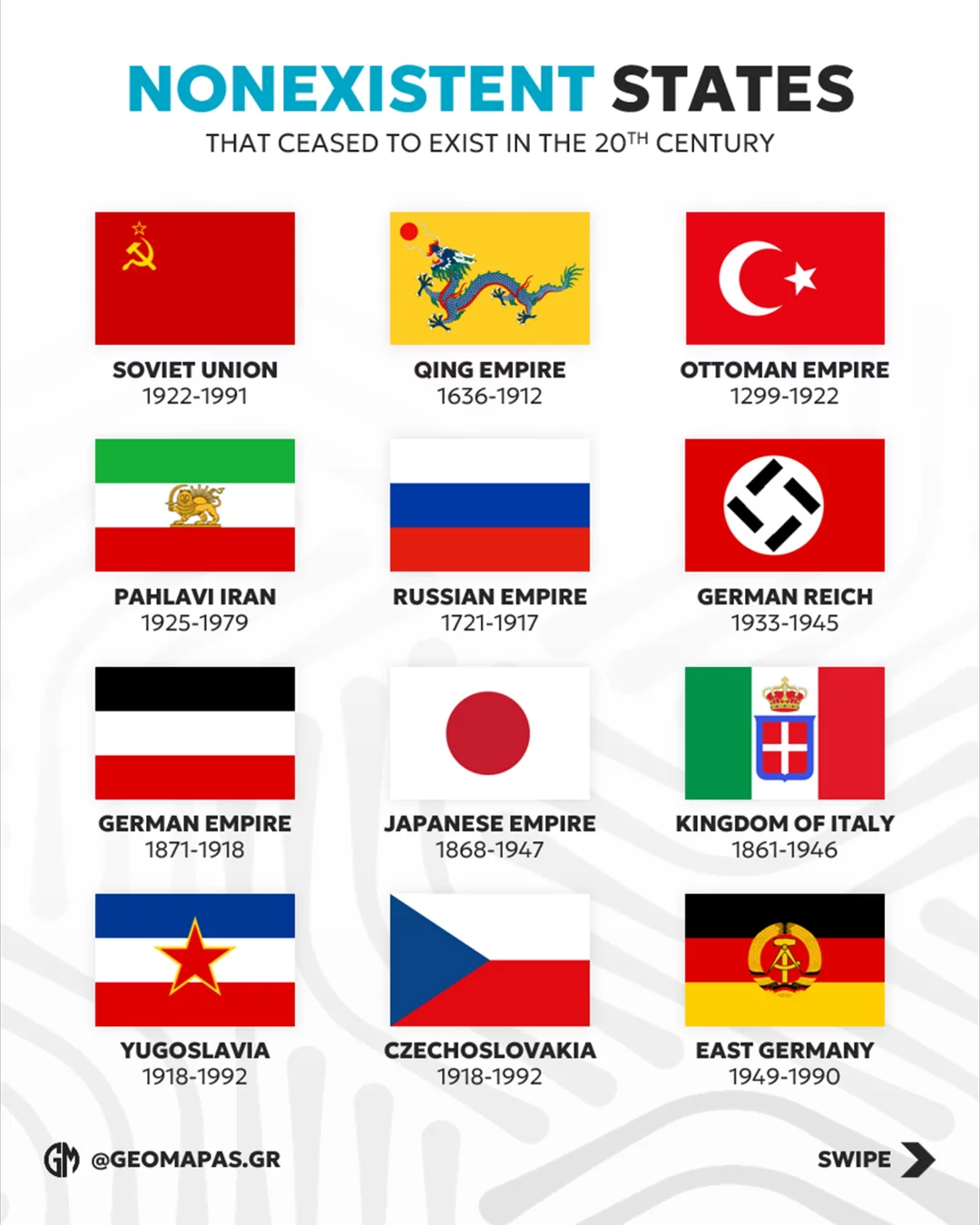
Soviet Union (1922–1991)
A communist superpower spanning much of Eurasia. It dissolved due to economic stagnation, political reforms under Mikhail Gorbachev (glasnost and perestroika), and rising nationalist movements within its republics. In 1991, it formally broke into 15 independent states.
Qing Empire (1636–1912)
China’s last imperial dynasty, ruled by the Manchu. It collapsed after internal rebellions, corruption, and pressure from foreign powers. The 1911 Revolution led to the establishment of the Republic of China.
Ottoman Empire (1299–1922)
A vast empire centered in modern Turkey. It declined over centuries and was dismantled after defeat in World War I. Nationalist movements and the Turkish War of Independence led to its replacement by the Republic of Turkey.
Pahlavi Iran (1925–1979)
A monarchy under the Pahlavi dynasty. It ended with the Iranian Revolution, which overthrew Shah Mohammad Reza Pahlavi and established the Islamic Republic of Iran.
Russian Empire (1721–1917)
An absolute monarchy ruled by the Tsars. It collapsed during World War I due to military failures, economic hardship, and popular unrest, culminating in the Russian Revolution and the rise of the Soviet state.
German Reich (1933–1945)
Nazi Germany under Adolf Hitler. It ended with total defeat in World War II, followed by occupation and division into East and West Germany.
German Empire (1871–1918)
A unified German state under the Kaiser. It collapsed after defeat in World War I, leading to the abdication of Kaiser Wilhelm II and the establishment of the Weimar Republic.
Japanese Empire (1868–1947)
An expansionist empire in East Asia. It effectively ended after defeat in World War II, followed by U.S. occupation and a new constitution transforming Japan into a constitutional monarchy.
Kingdom of Italy (1861–1946)
A unified Italian state under a monarchy. After World War II and the fall of fascism, a 1946 referendum abolished the monarchy and created the Italian Republic.
Yugoslavia (1918–1992)
A multi-ethnic federation in Southeast Europe. It disintegrated due to ethnic tensions, economic crisis, and nationalism after the Cold War, leading to a series of wars and the creation of several independent states.
Czechoslovakia (1918–1992)
Formed after World War I. It peacefully split in 1993 into the Czech Republic and Slovakia in what’s known as the “Velvet Divorce.”
East Germany (1949–1990)
A Soviet-aligned socialist state. It ceased to exist when Germany was reunified in 1990 after the fall of the Berlin Wall and the collapse of communist rule in Eastern Europe.
Countries 12-24
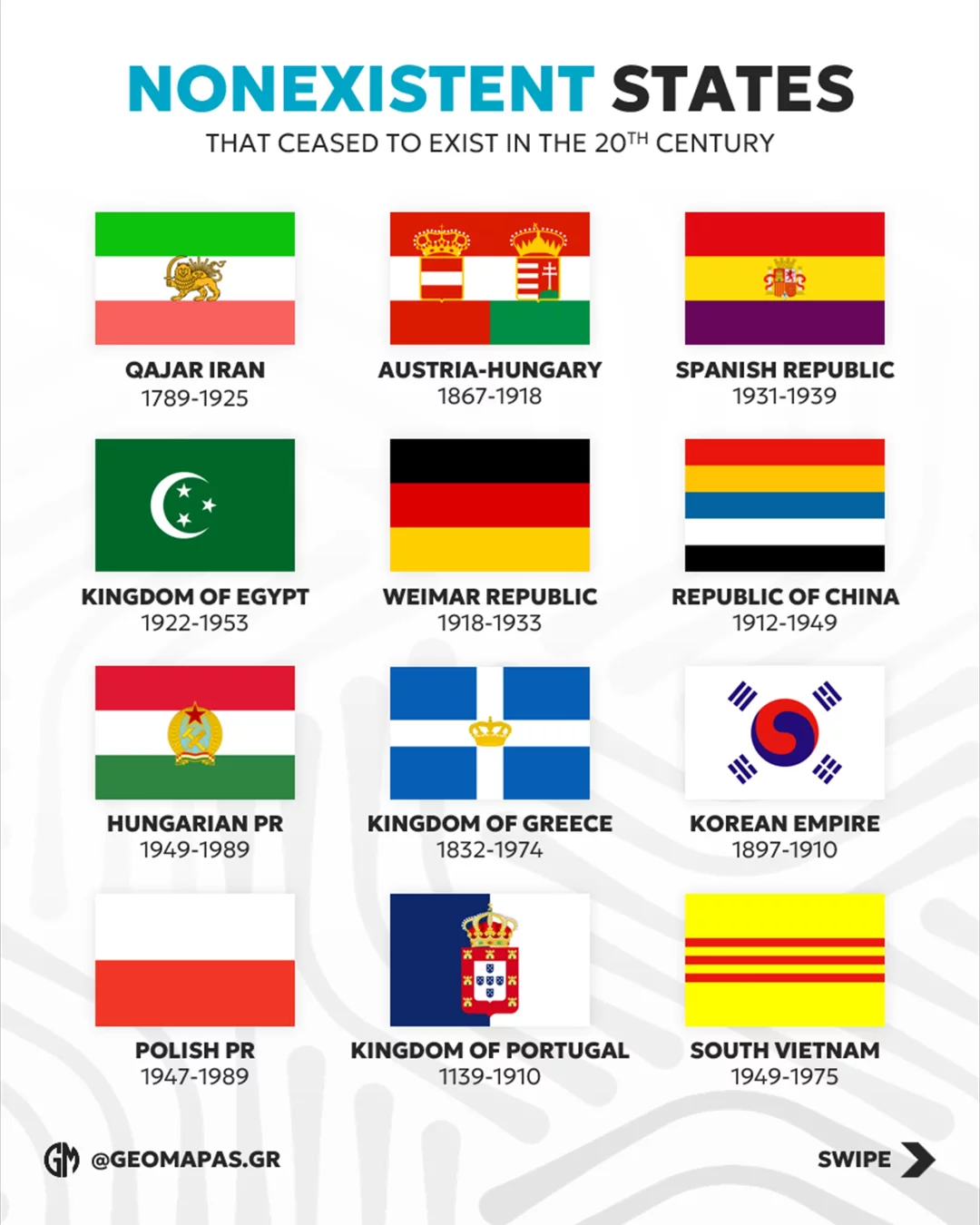
Qajar Iran (1789–1925)
A Persian monarchy weakened by internal corruption and foreign influence (especially Russia and Britain). It ended when Reza Khan staged a coup and founded the Pahlavi dynasty, modernizing and centralizing Iran.
Austria-Hungary (1867–1918)
A multi-ethnic empire in Central Europe. It collapsed after defeat in World War I, as nationalist movements led to the creation of several independent states like Austria, Hungary, Czechoslovakia, and Yugoslavia.
Spanish Republic (1931–1939)
A democratic government that replaced Spain’s monarchy. It ended after the Spanish Civil War, when Francisco Franco’s nationalist forces won and established a dictatorship.
Kingdom of Egypt (1922–1953)
A nominally independent monarchy after British control. It was overthrown by the 1952 revolution led by military officers (including Gamal Abdel Nasser), leading to the modern Republic of Egypt.
Weimar Republic (1918–1933)
Germany’s democratic government after World War I. It collapsed due to economic crises, political instability, and rising extremism, culminating in Adolf Hitler’s rise and the establishment of Nazi rule.
Republic of China (1912–1949)
Founded after the fall of the Qing dynasty (see above). It lost control of mainland China after the Chinese Civil War, when the Communists established the People’s Republic of China. The Republic of China government retreated to Taiwan, where it still exists today.
Hungarian People’s Republic (1949–1989)
A Soviet-aligned communist state. It ended as communist regimes collapsed across Eastern Europe in 1989, transitioning Hungary into a democratic republic.
Kingdom of Greece (1832–1974)
A monarchy established after independence from the Ottoman Empire. It was abolished following political instability and the fall of a military dictatorship, leading to a referendum that created the modern Greek republic.
Korean Empire (1897–1910)
A short-lived empire attempting to assert independence. It was annexed by Imperial Japan in 1910, ending Korean sovereignty until the end of World War II.
Polish People’s Republic (1947–1989)
A Soviet-influenced communist state. It ended with the fall of communism in Eastern Europe, driven by movements like Solidarity, leading to democratic reforms.
Kingdom of Portugal (1139–1910)
One of Europe’s oldest monarchies. It ended with the 1910 revolution, which overthrew the monarchy and established the Portuguese Republic.
South Vietnam (1949–1975)
An anti-communist state supported by the United States during the Cold War. It collapsed after the Vietnam War when North Vietnamese forces captured Saigon, leading to reunification under communist rule.
Countries 24-36
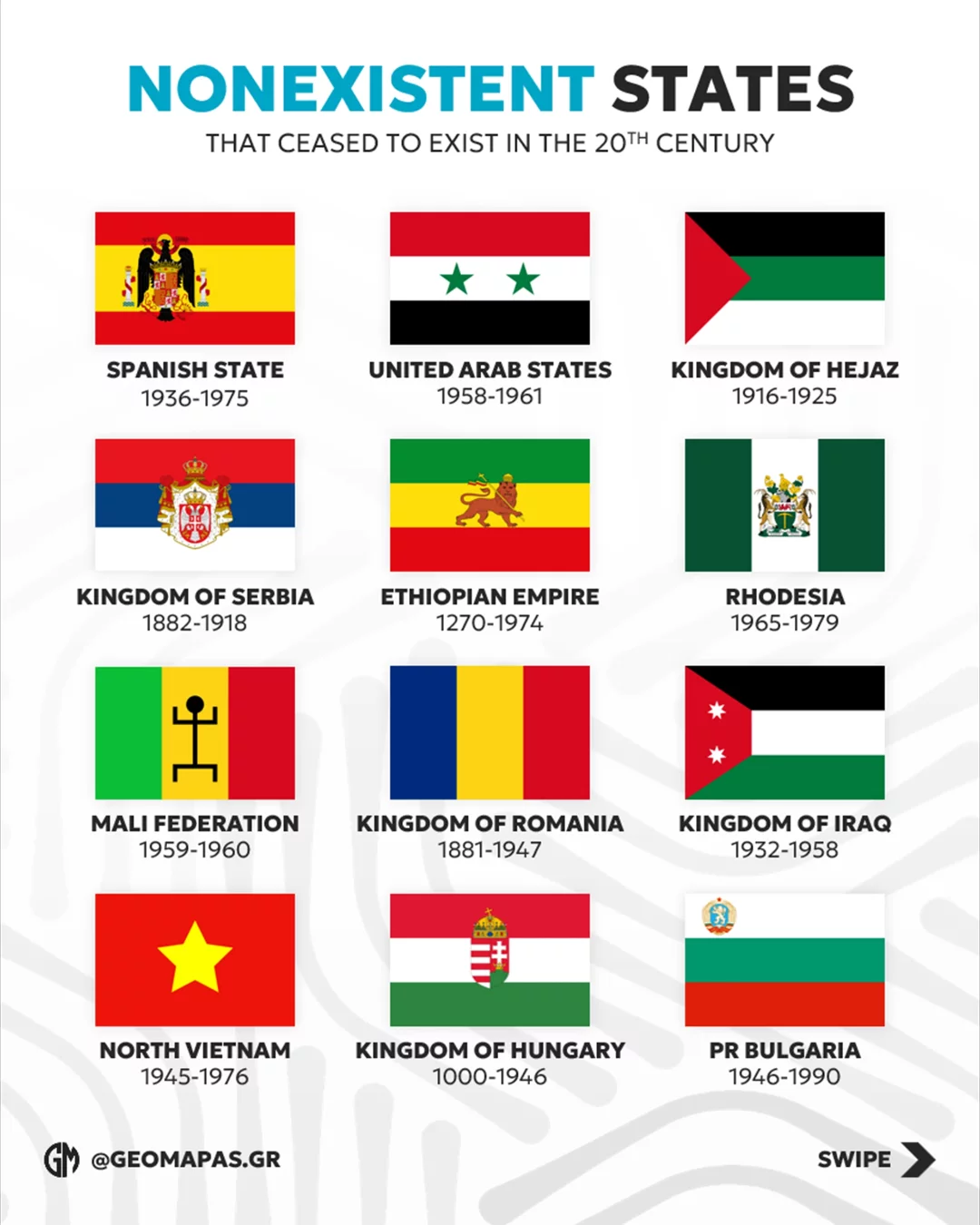
Spanish State (1936–1975)
An authoritarian regime under Francisco Franco following the Spanish Civil War. It ended with Franco’s death, after which Spain transitioned peacefully to a الديمقراطية and restored the monarchy.
United Arab States (1958–1961)
A short-lived political union between Egypt and Syria (closely tied to the United Arab Republic). It collapsed due to political imbalance and Syrian dissatisfaction, leading to Syria’s withdrawal.
Kingdom of Hejaz (1916–1925)
Established during World War I after revolting against the Ottoman Empire. It was conquered by Ibn Saud, becoming part of what is now Saudi Arabia.
Kingdom of Serbia (1882–1918)
An independent Balkan kingdom. After World War I, it merged with other South Slavic territories to form the Kingdom of Serbs, Croats, and Slovenes (later Yugoslavia).
Ethiopian Empire (1270–1974)
One of Africa’s oldest monarchies. It ended when Emperor Haile Selassie was overthrown in a military coup, leading to a socialist state under the Derg.
Rhodesia (1965–1979)
A self-declared state led by a white minority government after breaking from Britain. It ended after international pressure and guerrilla war, transitioning to Zimbabwe in 1980.
Mali Federation (1959–1960)
A brief union between Senegal and Mali. It dissolved quickly due to political disagreements, splitting into the independent states of Senegal and Mali.
Kingdom of Romania (1881–1947)
A monarchy that shifted alliances during World War II. It ended when the Soviet-backed communist government forced King Michael I to abdicate, establishing a republic.
Kingdom of Iraq (1932–1958)
A monarchy established after British mandate rule. It ended with a military coup that killed the royal family and created a republic.
North Vietnam (1945–1976)
A communist state in northern Vietnam. It ceased to exist after victory in the Vietnam War, when it unified with South Vietnam to form the Socialist Republic of Vietnam.
Kingdom of Hungary (1000–1946)
A long-standing monarchy that effectively ended after World War I, though formally abolished after World War II when Hungary became a republic under Soviet influence.
People’s Republic of Bulgaria (1946–1990)
A Soviet-aligned communist state. It ended with the fall of communism in Eastern Europe, transitioning into a democratic republic.
Countries 36-48
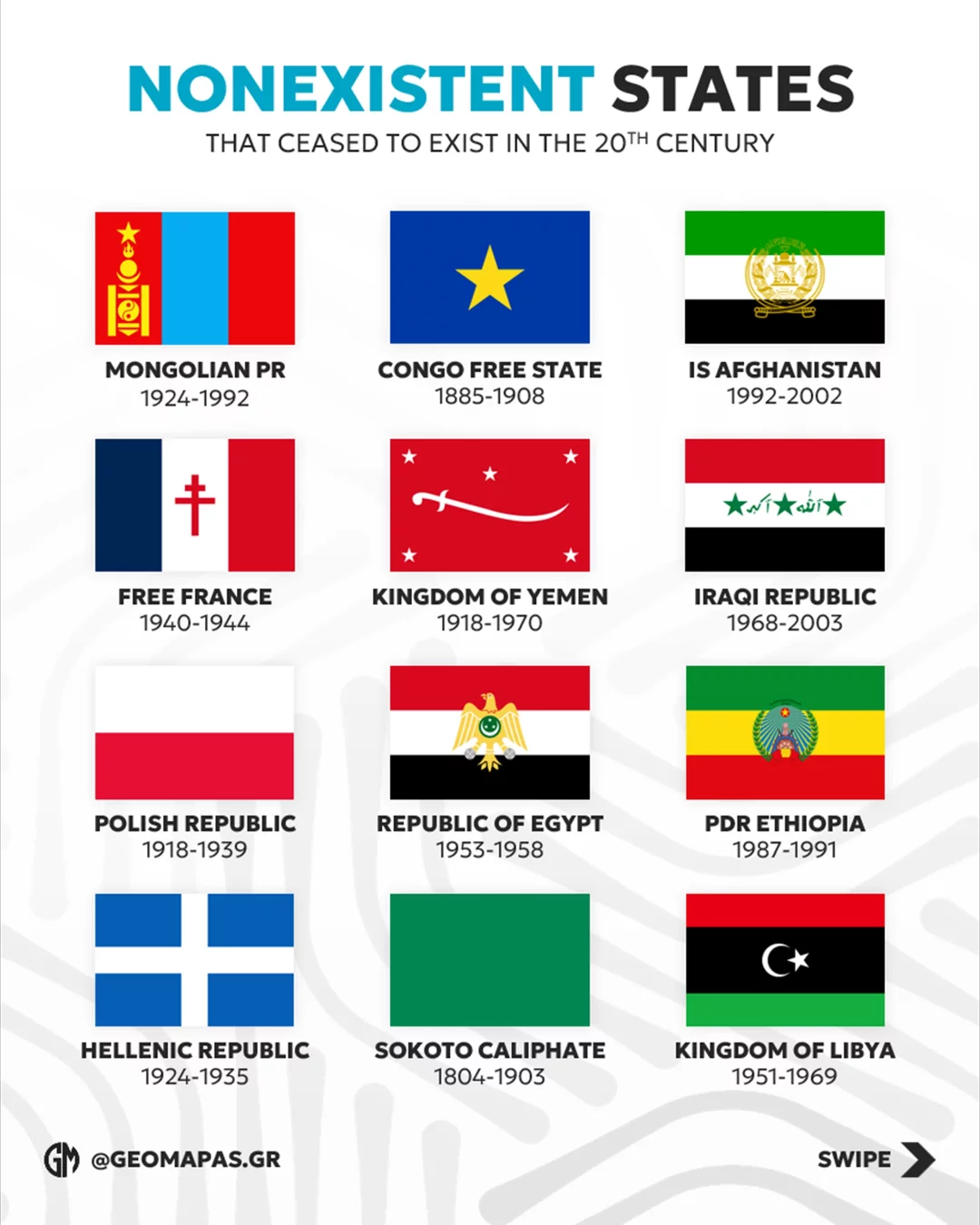
Mongolian People’s Republic (1924–1992)
A Soviet-aligned communist state. It ended with the collapse of communism in 1992, transitioning into a democratic Mongolia.
Congo Free State (1885–1908)
Personally controlled by Belgium’s King Leopold II, notorious for extreme exploitation and atrocities. International outrage forced Belgium to annex it, turning it into the Belgian Congo.
Islamic State of Afghanistan (1992–2002)
Formed after the fall of the communist government. It was weakened by civil war and largely replaced by Taliban rule, then formally ended after the U.S.-led intervention in 2001–2002.
Free France (1940–1944)
A government-in-exile led by Charles de Gaulle during Nazi occupation. It ceased when France was liberated and a provisional government restored sovereignty.
Kingdom of Yemen (1918–1970)
A traditional monarchy in North Yemen. It ended after a civil war between royalists and republicans, resulting in the Yemen Arab Republic.
Iraqi Republic (1968–2003)
Ruled by the Ba’ath Party, including Saddam Hussein. It ended after the 2003 U.S.-led invasion, which toppled the regime and led to a new political system.
Second Polish Republic (1918–1939)
Restored after World War I. It ceased when Germany and the Soviet Union invaded and partitioned Poland at the start of World War II.
Republic of Egypt (1953–1958)
Established after the monarchy was overthrown. It ceased when Egypt merged with Syria to form the United Arab Republic.
People’s Democratic Republic of Ethiopia (1987–1991)
A Marxist-Leninist regime. It collapsed due to internal rebellion, economic issues, and the end of Soviet support, leading to a new federal republic.
Second Hellenic Republic (1924–1935)
A republican period between Greek monarchies. It ended when the monarchy was restored after political instability and military influence.
Sokoto Caliphate (1804–1903)
A major Islamic state in West Africa. It was conquered and incorporated into the British colonial system (Northern Nigeria).
Kingdom of Libya (1951–1969)
An independent monarchy under King Idris. It ended with a military coup led by Muammar Gaddafi, establishing a republic.
Countries 48-60
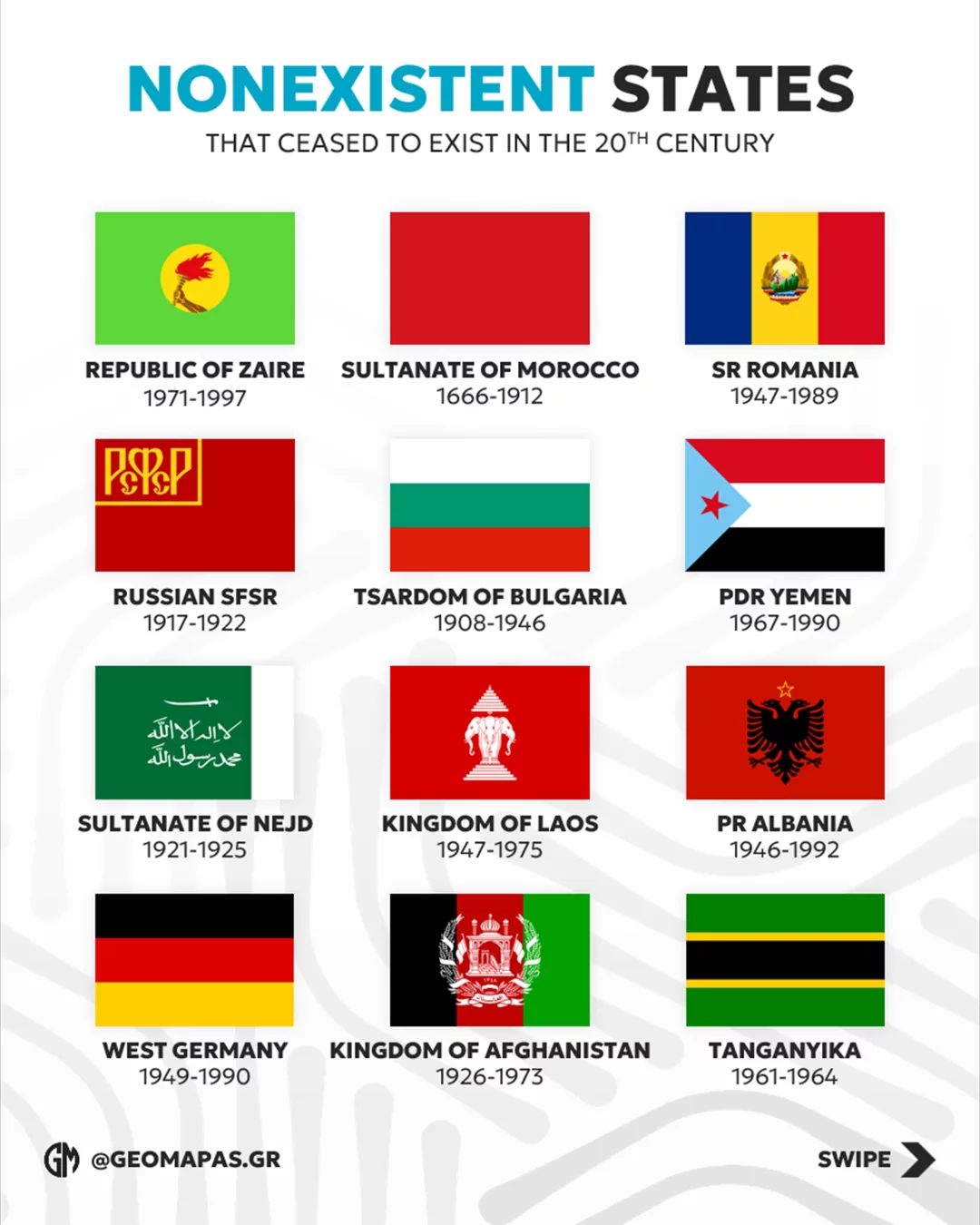
Republic of Zaire (1971–1997)
Renamed from Congo under Mobutu Sese Seko. It collapsed after a rebellion led by Laurent Kabila, who overthrew Mobutu and restored the name Democratic Republic of the Congo.
Sultanate of Morocco (1666–1912)
A traditional monarchy. It formally ended when Morocco became a French and Spanish protectorate, losing full sovereignty until independence in 1956.
Socialist Republic of Romania (1947–1989)
A communist regime under leaders like Nicolae Ceaușescu. It ended violently during the 1989 revolution, transitioning to a democratic republic.
Russian Soviet Federative Socialist Republic (1917–1922)
The first Soviet state formed after the Russian Revolution. It ceased as a separate entity when it became the core republic of the newly formed Soviet Union in 1922.
Tsardom of Bulgaria (1908–1946)
A monarchy that aligned with Axis powers in World War II. It ended when a Soviet-backed government abolished the monarchy and declared a republic.
People’s Democratic Republic of Yemen (1967–1990)
A socialist state in southern Yemen. It ceased when it unified with North Yemen to form the modern Republic of Yemen.
Sultanate of Nejd (1921–1925)
A state ruled by Ibn Saud in central Arabia. It merged with the Kingdom of Hejaz and other territories, forming the foundation of modern Saudi Arabia.
Kingdom of Laos (1947–1975)
A monarchy caught in Cold War conflict. It ended when communist forces (Pathet Lao) took power, establishing the Lao People’s Democratic Republic.
People’s Socialist Republic of Albania (1946–1992)
A rigid communist regime. It collapsed with the fall of communism in Eastern Europe, transitioning to a democratic system.
West Germany (1949–1990)
A democratic state formed after World War II. It ceased as a separate state when Germany reunified in 1990 with East Germany.
Kingdom of Afghanistan (1926–1973)
A monarchy that attempted modernization. It ended after a coup by Mohammed Daoud Khan, who declared a republic.
Tanganyika (1961–1964)
An independent state after British rule. It merged with Zanzibar in 1964 to form Tanzania.
Countries 60-72
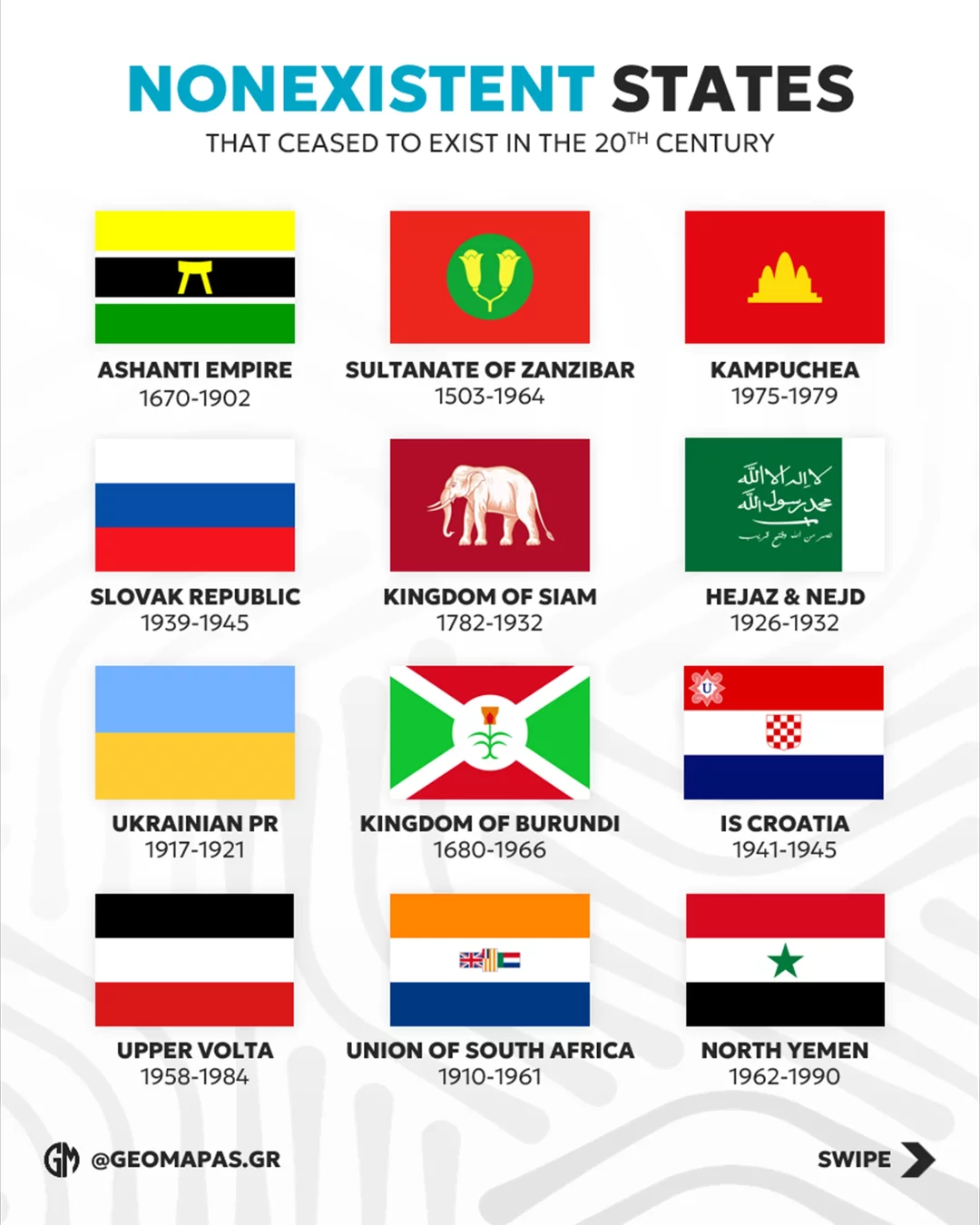
Ashanti Empire (1670–1902)
A powerful West African state in present-day Ghana. It was defeated by the British after a series of wars and incorporated into the British Gold Coast colony.
Sultanate of Zanzibar (1503–1964)
A trading empire off East Africa. It ended after the 1964 revolution, which overthrew the Arab ruling elite and led to union with Tanganyika to form Tanzania.
Democratic Kampuchea (1975–1979)
A radical communist regime under the Khmer Rouge. It collapsed after Vietnam invaded Cambodia and removed the regime.
Slovak Republic (1939–1945)
A Nazi-aligned state during World War II. It ended with the defeat of Germany and reintegration into Czechoslovakia.
Kingdom of Siam (1782–1932)
The historical name of Thailand under absolute monarchy. It transitioned into a constitutional monarchy after a bloodless revolution in 1932.
Kingdom of Hejaz and Nejd (1926–1932)
A transitional state under Ibn Saud. It unified into the modern Kingdom of Saudi Arabia in 1932.
Ukrainian People’s Republic (1917–1921)
A short-lived independent state after the Russian Empire collapsed. It was defeated by Bolshevik forces and incorporated into the Soviet Union.
Kingdom of Burundi (1680–1966)
A traditional monarchy. It ended after political instability and a military coup that established a republic.
Independent State of Croatia (1941–1945)
A Nazi puppet state during World War II. It collapsed with the defeat of Axis powers and was absorbed into socialist Yugoslavia.
Upper Volta (1958–1984)
A post-colonial state in West Africa. It was renamed Burkina Faso in 1984 following a revolutionary government.
Union of South Africa (1910–1961)
A British dominion. It ceased when South Africa became a republic and left the Commonwealth in 1961.
Yemen Arab Republic (1962–1990)
A republican state formed after overthrowing the monarchy. It ceased when it unified with South Yemen to form the modern Republic of Yemen.
Countries 72-84
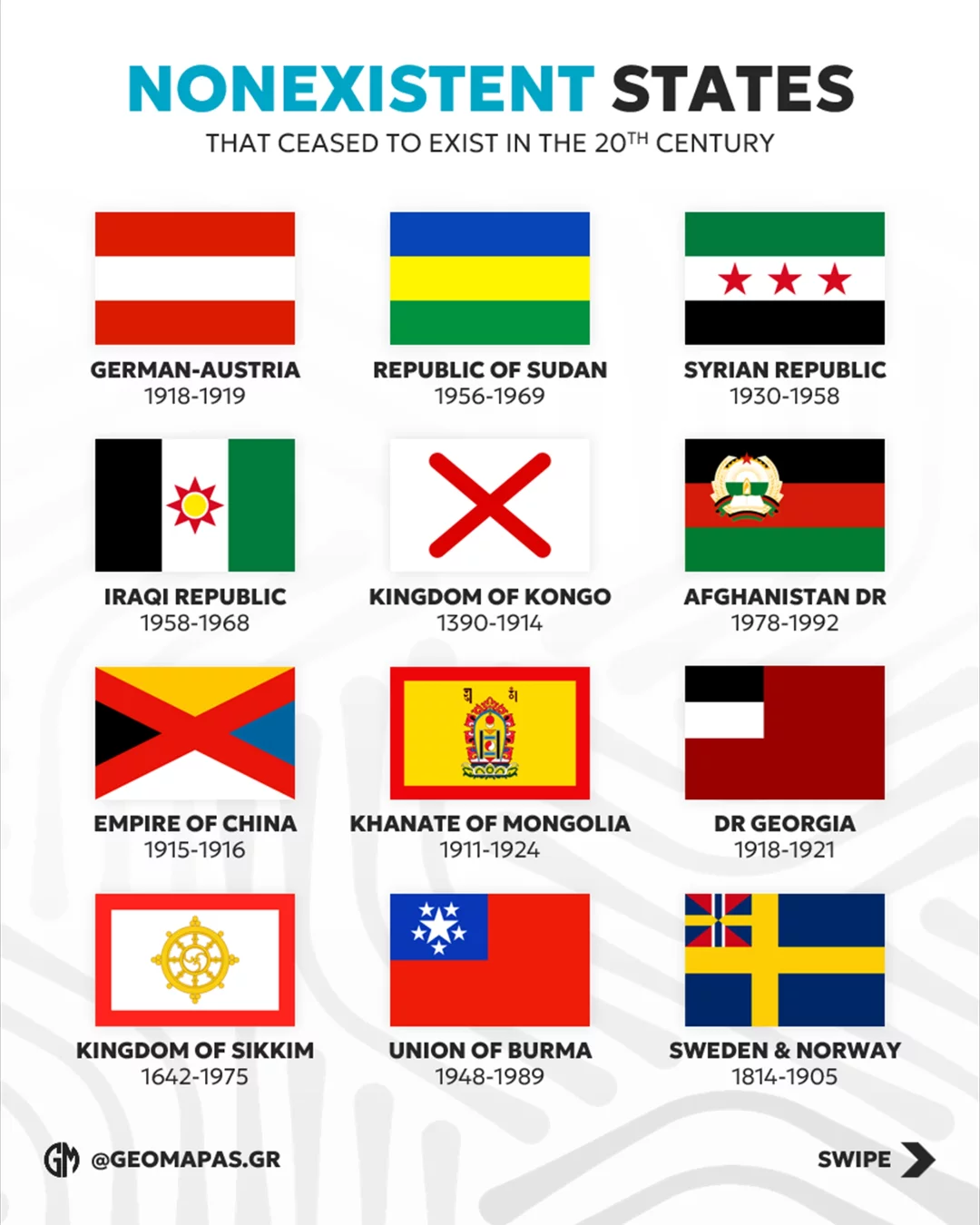
German-Austria (1918–1919)
A short-lived state formed after the Austro-Hungarian Empire collapsed. It aimed to unite with Germany but was prohibited by the Treaty of Saint-Germain, becoming the Republic of Austria instead.
Republic of Sudan (1956–1969)
Sudan’s initial post-independence republic. It ended after a military coup in 1969 that established a new regime under Jaafar Nimeiry.
Syrian Republic (1930–1958)
An independent republic following the French mandate. It ceased when Syria joined Egypt to form the United Arab Republic.
Iraqi Republic (1958–1968)
Established after overthrowing the monarchy. It ended with a coup that brought the Ba’ath Party to power, leading to a new political phase.
Kingdom of Kongo (1390–1914)
A long-standing Central African kingdom. It gradually declined and was ultimately absorbed into Portuguese colonial territories.
Democratic Republic of Afghanistan (1978–1992)
A Soviet-backed communist state. It collapsed after years of war, loss of Soviet support, and the rise of mujahideen forces.
Empire of China (1915–1916)
A brief attempt by Yuan Shikai to restore monarchy. It failed due to widespread opposition and was quickly abandoned.
Bogd Khanate of Mongolia (1911–1924)
A Buddhist theocratic monarchy after independence from Qing China. It ended when a Soviet-backed revolution established a communist state.
Democratic Republic of Georgia (1918–1921)
A short-lived independent republic after the Russian Empire’s fall. It was invaded and absorbed into the Soviet Union.
Kingdom of Sikkim (1642–1975)
A small Himalayan kingdom. It ended when it was annexed by India following a referendum.
Union of Burma (1948–1989)
The post-independence state of Burma. It was renamed Myanmar in 1989 under military rule, marking a new political phase.
Sweden and Norway (1814–1905)
A union under a single monarch. It ended peacefully when Norway declared independence and the union was dissolved.
Countries 84-96
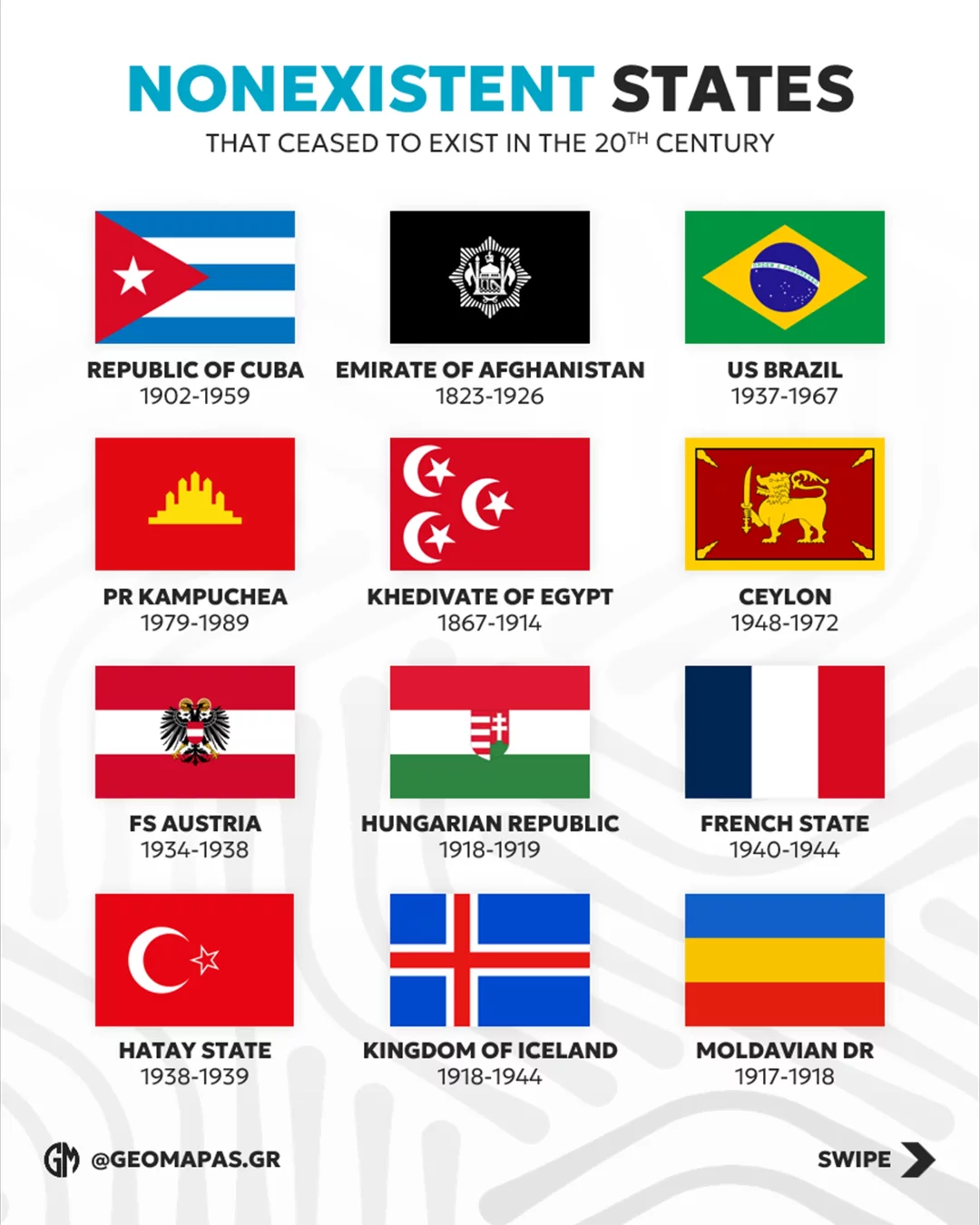
Republic of Cuba (1902–1959)
An independent republic heavily influenced by the United States. It ended after the Cuban Revolution, when Fidel Castro overthrew the government and established a socialist state.
Emirate of Afghanistan (1823–1926)
A traditional monarchy. It transitioned into the Kingdom of Afghanistan as part of modernization reforms under Amanullah Khan.
Estado Novo Brazil (1937–1967)
An authoritarian regime under Getúlio Vargas. It ended with political liberalization and the establishment of a new constitutional framework (later followed by military rule).
People’s Republic of Kampuchea (1979–1989)
A communist government installed after Vietnam overthrew the Khmer Rouge. It transitioned into a new political system as Cold War dynamics shifted.
Khedivate of Egypt (1867–1914)
An autonomous province of the Ottoman Empire. It ended when Britain declared a protectorate during World War I.
Ceylon (1948–1972)
An independent dominion after British rule. It ceased when the country adopted a republican constitution and was renamed Sri Lanka.
Federal State of Austria (1934–1938)
An authoritarian regime. It ended when Nazi Germany annexed Austria in the Anschluss.
Hungarian Democratic Republic (1918–1919)
A short-lived republic after World War I. It collapsed amid political chaos and was replaced by a communist regime (Hungarian Soviet Republic).
Vichy France (1940–1944)
A collaborationist regime during Nazi occupation. It ended with the liberation of France and restoration of the republic.
Hatay State (1938–1939)
A short-lived independent state. It was annexed by Turkey after a referendum.
Kingdom of Iceland (1918–1944)
A sovereign state in personal union with Denmark. It became a fully independent republic in 1944.
Moldavian Democratic Republic (1917–1918)
A short-lived state after the Russian Empire’s collapse. It merged with Romania shortly after its creation.
Countries 96-108
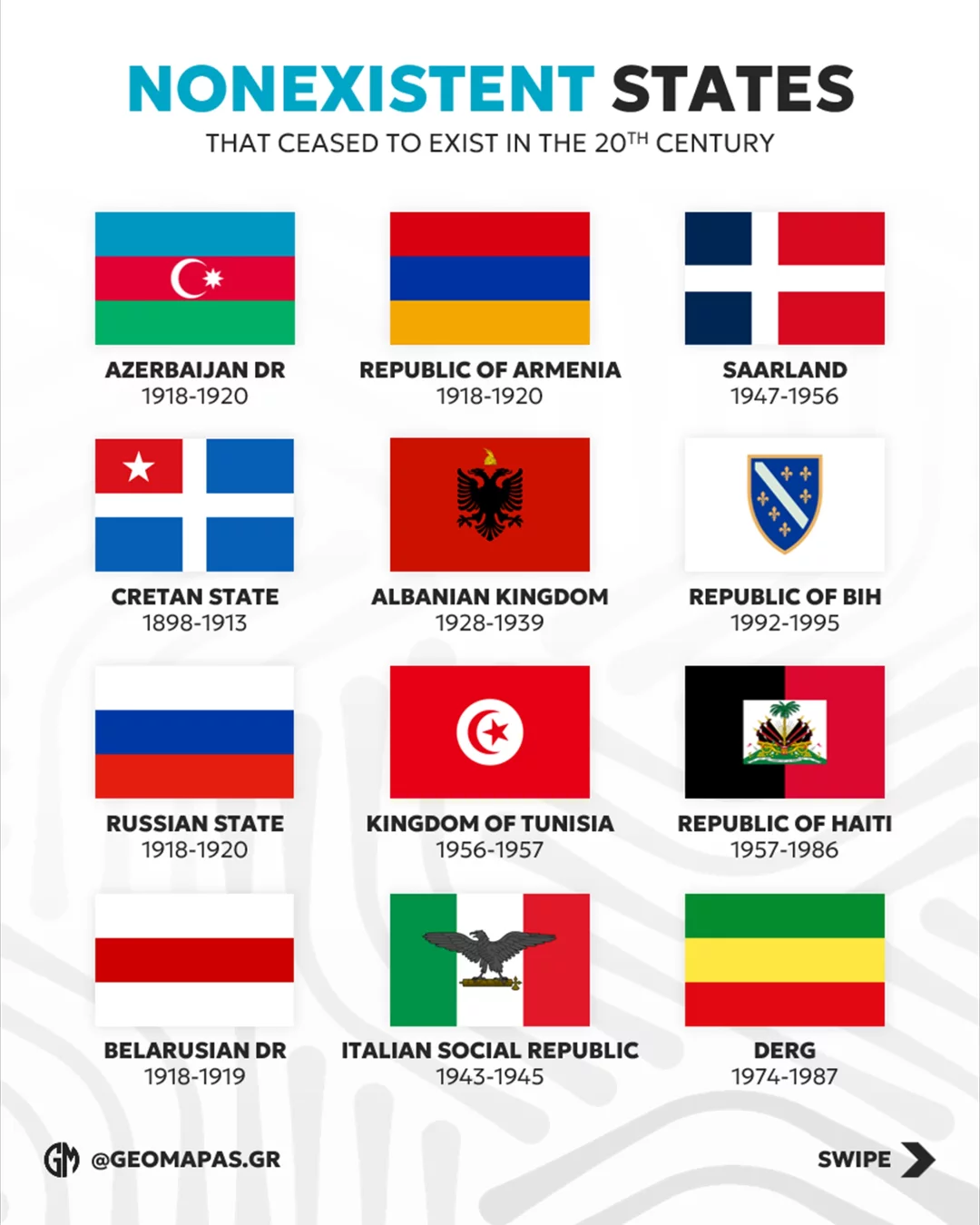
Azerbaijan Democratic Republic (1918–1920)
A short-lived independent state after the Russian Empire collapsed. It ended when the Red Army invaded and incorporated it into the Soviet Union.
First Republic of Armenia (1918–1920)
Established after World War I. It ceased when Soviet forces took control, forming the Armenian Soviet Socialist Republic.
Saarland (1947–1956)
A territory under French control after World War II. It ceased as a separate entity when it rejoined West Germany following a referendum.
Cretan State (1898–1913)
An autonomous state under Ottoman suzerainty with international oversight. It ended when Crete united with Greece.
Albanian Kingdom (1928–1939)
A monarchy under King Zog I. It ended when Italy invaded and annexed Albania before World War II.
Republic of Bosnia and Herzegovina (1992–1995)
Declared independence from Yugoslavia. It transitioned into its current form after the Dayton Agreement ended the Bosnian War.
Russian State (1918–1920)
An anti-Bolshevik government during the Russian Civil War. It collapsed after defeat by the Red Army.
Kingdom of Tunisia (1956–1957)
A short-lived monarchy after independence from France. It ended when Tunisia became a republic.
Duvalier-era Haiti (1957–1986)
A dictatorship under François and Jean-Claude Duvalier. It ended with the fall of the regime and transition toward a new political system.
Belarusian Democratic Republic (1918–1919)
A short-lived state after the Russian Empire’s collapse. It was overtaken by Soviet forces and incorporated into the USSR.
Italian Social Republic (1943–1945)
A Nazi puppet state in northern Italy during World War II. It collapsed with the defeat of Axis forces.
Derg (1974–1987)
A Marxist military junta that overthrew the Ethiopian monarchy. It ended when a new socialist constitution created the People’s Democratic Republic of Ethiopia.
Countries 108-120
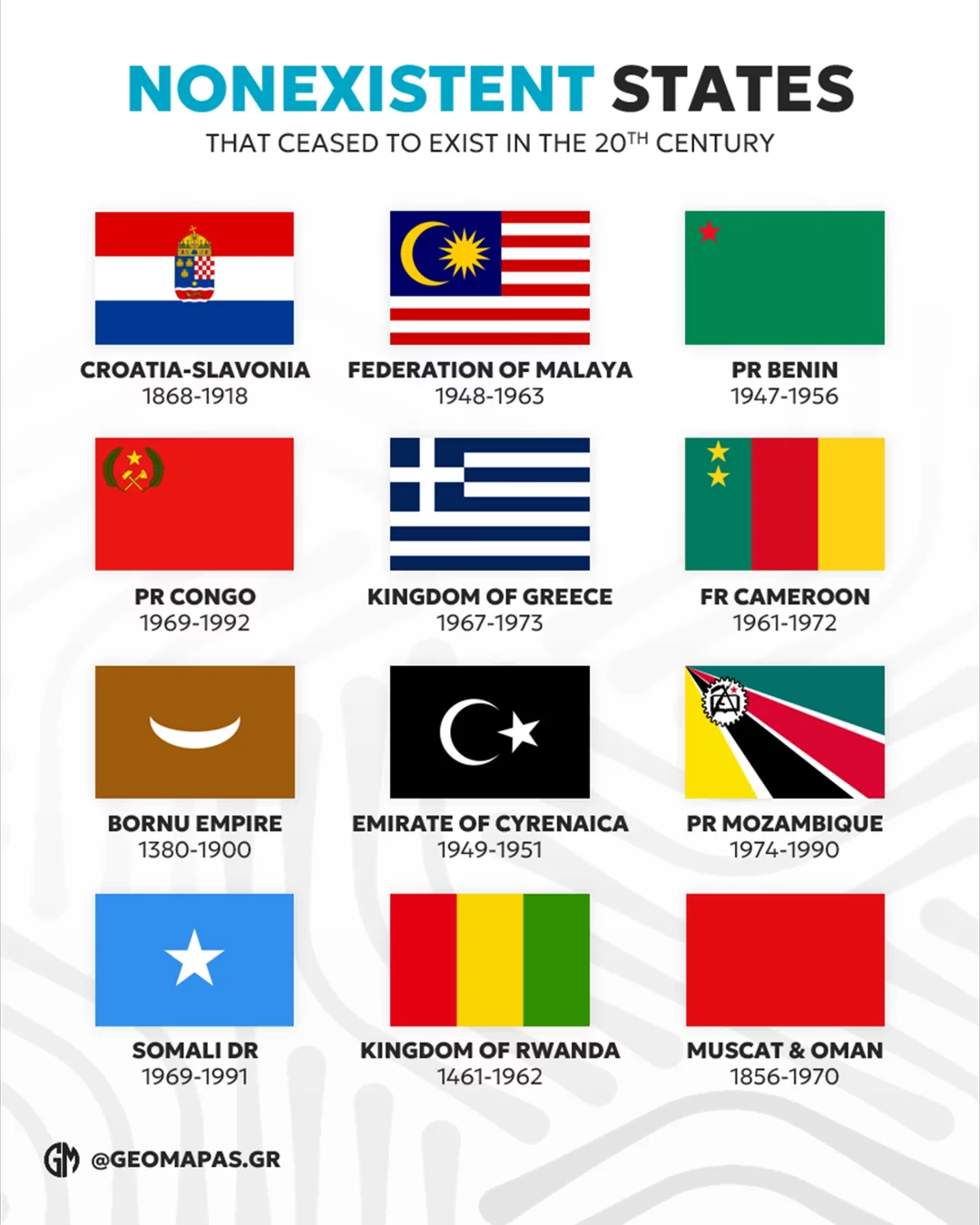
Kingdom of Croatia-Slavonia (1868–1918)
An autonomous kingdom within Austria-Hungary. It ceased after World War I when it joined the newly formed Kingdom of Serbs, Croats, and Slovenes (later Yugoslavia).
Federation of Malaya (1948–1963)
A federation formed after British rule. It ended when it expanded to include other territories, forming Malaysia in 1963.
People’s Republic of Benin (1975–1990)
A Marxist-Leninist state in West Africa. It ended with democratic reforms and the abandonment of communism.
People’s Republic of the Congo (1969–1992)
A Soviet-aligned state. It transitioned to a multi-party republic after the end of the Cold War.
Kingdom of Greece (1967–1973)
A monarchy during a period dominated by a military junta. It ended when the monarchy was abolished and a republic declared.
Federal Republic of Cameroon (1961–1972)
A federal state combining former British and French territories. It ended when the country centralized into a unitary state.
Bornu Empire (1380–1900)
A long-standing Sahelian empire. It declined due to internal weakness and external pressure, eventually falling under colonial control.
Emirate of Cyrenaica (1949–1951)
A semi-independent emirate under British supervision. It ceased when it joined Tripolitania and Fezzan to form the Kingdom of Libya.
People’s Republic of Mozambique (1975–1990)
A socialist state after independence from Portugal. It transitioned away from Marxism and toward a multi-party system.
Somali Democratic Republic (1969–1991)
A military socialist regime. It collapsed after civil war and the overthrow of Siad Barre, leading to state fragmentation.
Kingdom of Rwanda (1461–1962)
A traditional monarchy. It ended after a revolution and independence from Belgium, leading to a republic.
Sultanate of Muscat and Oman (1856–1970)
A sultanate that evolved into the modern state of Oman after internal consolidation and modernization under Sultan Qaboos.
Which one do you miss the most?
Leave a Reply